
Why per-seat pricing punishes small teams
Per-seat pricing turns every new face into a budget decision. Whole-team cost tables for 5, 8, 10 and 20 people, and where per-seat still makes sense.
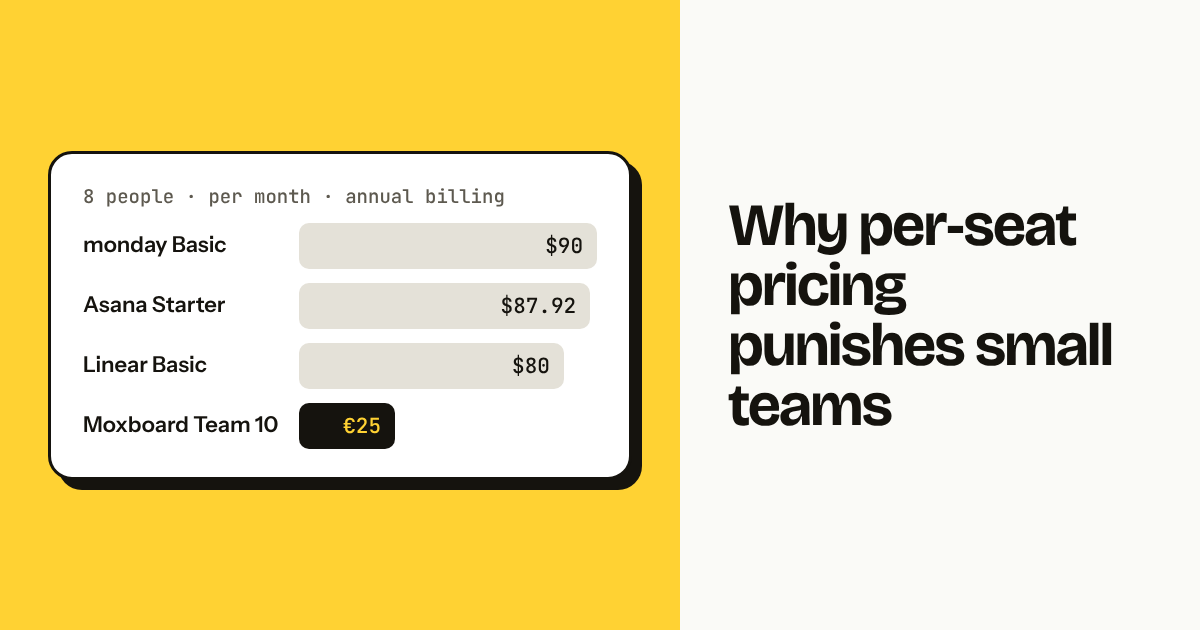
Per-seat pricing punishes small teams because it charges for people, and a small team's people are not interchangeable units of value. In a 6-person company, the contractor, the client and the designer who checks the board once a week are all "seats", each one a line on the invoice and a small budget decision. People ration access, the board stops being the whole team's board, and the bill creeps up without anyone ever deciding to spend more.
TL;DR
- Per-seat pricing was designed for enterprises where head count tracks value. In a small team it taxes collaboration itself: every added person is a cost.
- Seat minimums and bucket pricing hide extra cost. monday sells seats in buckets of 3 then 5, so 6 people pay for 10. Asana requires at least 2 paid seats.
- For 8 people, Asana Starter is $87.92 a month, Linear Basic $80, monday Basic $90; Moxboard Team 10 is €25 for the whole workspace, with every feature included. Per-seat still makes sense in a few specific cases, listed below.
Who was per-seat pricing designed for?
Enterprises, where the number of seats is a reasonable proxy for the value a tool delivers. If a 4,000-person company adds 400 people to a project tool, it gets roughly 10% more value, and procurement likes a price that maps onto departmental head count. Per-seat pricing is honest in that setting.
A 6-person company is not a small enterprise. The sixth person might be a co-founder working 70-hour weeks or an accountant who opens the tool twice a month. Charging both the same is where the model breaks.
The vendors know this, which is why most offer a free tier for small groups: Asana Personal up to 10 users, Trello Free up to 10 collaborators, Jira Free up to 10 users. The free tier is the acknowledgement that per-seat does not fit small teams. The problem starts the day a team needs one paid feature, because then every person becomes a paid seat.
What does per-seat pricing actually do to a small team?
Three things, and none of them show up on the pricing page.
People ration access. The designer who comes in one day a week does not get a seat; someone screenshots the board for her. The client is not invited; status goes out as a weekly email. The new hire waits until the end of probation. Each decision is sensible on its own. Together they mean the board is no longer the whole team's board, which was the only reason to have one.
The bill creeps with no decision point. A team on Asana Starter at $10.99 per seat adds one person in March, one in June, a contractor in September. Nobody approved a 60% increase in the budget; it happened one invite at a time. No one ever saw the old price and the new price side by side and said yes.
Seat minimums and buckets add cost you did not ask for. Asana's paid plans require at least 2 seats. monday.com has a 3-seat minimum and sells seats in buckets of 3, then multiples of 5, so a 6-person team pays for 10 seats. Trello, Linear and ClickUp bill exact head count, but the general pattern is that the published per-seat number is a floor.
[Image: illustration of a 6-person team where 4 have board access and 2 are receiving screenshots by chat, light theme, landscape]
How much does a whole team actually pay?
Here is the monthly cost for the whole team on the entry paid plan of each tool, billed annually, at four team sizes (checked November 2026). Moxboard is priced per workspace in euros; the others are per user per month in dollars.
| Team size | Moxboard | Asana Starter | Trello Standard | Trello Premium | Linear Basic | ClickUp Unlimited | monday Basic |
|---|---|---|---|---|---|---|---|
| 5 people | €15 (Team 5) | $54.95 | $25 | $50 | $50 | $35 | $45 |
| 8 people | €25 (Team 10) | $87.92 | $40 | $80 | $80 | $56 | $90* |
| 10 people | €25 (Team 10) | $109.90 | $50 | $100 | $100 | $70 | $90 |
| 20 people | €45 (Team 20) | $219.80 | $100 | $200 | $200 | $140 | $180 |
* monday Basic for 8 people is 8 × $9 = $72 on paper, but seats are sold in buckets, so in practice 10 seats = $90.
Prices change; check the official pricing page before deciding: Asana, Trello, Linear, ClickUp, monday.com.
Two honest notes on the table. Trello Standard at $5 per user is cheap enough that for 3 people it costs the same as Moxboard (€15 against $15), and Trello's free plan covers 10 collaborators with 10 boards, which many small teams never outgrow. On the other side, Trello Standard has no Timeline or Dashboard (those are Trello Premium, $10 per user), while every Moxboard plan has both, plus Reports across projects. And these are entry plans: Asana Starter includes forms, custom fields and a workflow builder, none of which Moxboard has today (forms are coming soon). You are not comparing identical products; you are comparing what each one charges for a team to share a board.
The detailed version for one team size is in how much does Asana cost for 8 people.
When does per-seat pricing make sense?
In at least three situations, and a small team in one of them should not switch models to make a point.
Very uneven usage across a large group. If 3 people live in the tool and 40 open it quarterly, per-seat with a free viewer role (Asana's and Linear's guest tiers, Trello's free collaborators) charges you for the 3, not the 40. A workspace price that counted all 43 would cost more.
Enterprise procurement that wants per-head accounting. Larger customers often allocate software cost to departments by head count. Per-seat pricing gives them an invoice that does that without a spreadsheet. A real need, just not a small-team one.
Tools where each seat consumes expensive compute. An AI coding assistant or a video rendering service costs the vendor materially more per active user, and per-seat pricing reflects that. A kanban board does not get more expensive to serve when a fifth person drags a card.
What is per-workspace pricing and how does Moxboard do it?
Per-workspace pricing charges one price for the whole workspace, in tiers by member count, instead of a price per person. Moxboard is a simple kanban board for small teams, with one price per workspace, set by team size, instead of per-user billing. Every plan includes every feature, Free included; you only pay for team size and storage. The sizes are:
| Members in the workspace | Moxboard plan | Monthly | Yearly |
|---|---|---|---|
| Up to 2 | Free (1 GB) | €0 | €0 |
| Up to 5 | Team 5 (20 GB) | €15 | €150 |
| Up to 10 | Team 10 (50 GB) | €25 | €250 |
| Up to 20 | Team 20 (100 GB) | €45 | €450 |
| Up to 50 | Team 50 (200 GB) | €100 | €1,000 |
| Up to 100 | Team 100 (500 GB) | €175 | €1,750 |
| More than 100 | Custom | Contact us |
Prices are per workspace, in euros, VAT excluded. Yearly plans are 10 months' price for 12 months. Extra storage is €5 a month per 100 GB on any paid plan. The full table is on the pricing page, and the definition article is what is per-workspace pricing.
Three rules address the three problems above.
Guests don't count. A guest is read-only and sees only the projects you choose. The client, the accountant, the investor watching progress: all guests, all free, no rationing. Owners, admins and members count; pending invitations count because they will become members. See what counts as a member.
The price changes only at team sizes, with confirmation. Going from 2 to 3 members moves the workspace from Free to Team 5 at €15. Going from 5 to 6 moves it to Team 10 at €25, from 10 to 11 to Team 20 at €45, from 20 to 21 to Team 50 at €100, from 50 to 51 to Team 100 at €175. At each step, the invite that would raise the price shows the current and new price and asks for confirmation first. Inside a size, adding a person costs nothing. When members leave and the team fits a smaller size, the lower price applies from the next period.
No minimums, no feature gates. A 6-person team pays the same €25 as a 10-person team because that is the size, and both get every feature. Nobody upgrades to unlock Timeline, Dashboard, Reports or Slack.
[Image: Moxboard invite dialog showing "Inviting this member changes your price from €25 to €45/month" with a confirm button, light theme, landscape]
Does per-workspace pricing have a downside?
Yes, two. It is not cheaper for everyone, and it needs honest tier boundaries.
It is not always cheaper. A 2-person team on Trello Standard pays $10 a month; Moxboard Free covers 2 members with every feature and 1 GB of files, so that is free versus $10. But a 3-person team is on Team 5 at €15, the same as $15 on Trello Standard, and 6 people pay €25 against $30. A solo user has no reason to care about per-workspace pricing. The model is cheapest near the top of each size: at 10, 20, 50 or 100 people, Moxboard is half of Trello Standard or less, and Trello Standard still has no Timeline or Dashboard. If a free plan is all you need, Trello Free and Asana Personal cover up to 10 people; Moxboard Free stops at 2.
Size boundaries create cliffs. The jump from 10 to 11 members takes the price from €25 to €45 a month, a €20 step, about four Trello Standard seats at once. Smaller steps sit at 5 to 6 (€15 to €25) and 2 to 3 (Free to €15). The confirmation step exists so you never discover the cliff on an invoice, but a cliff with a warning is still a cliff, and a team hovering at 10 will feel it. That is the trade for not paying for members 12 through 20.
[Image: Moxboard board with 11 cards MOX-14 to MOX-24, columns To do / In progress (header "3 / 3") / In review / Done, types Bug/Feature/Feedback, 4 assignees, one stale card, light theme, landscape]
What should a small team do about it?
Count the people who need to see the board, not the people who need to edit it. Then price out the real number on each tool, including minimums and buckets. The table above is a start; the official pricing pages are the source of truth.
Then ask whether the paid features are ones you use. The 5-person team Moxboard was built for paid Asana per seat for one board and used none of the Starter features. That is the common small-team situation: the per-seat bill is buying a shared board, and a shared board does not cost more when the seventh person joins a team of up to 10.
If you are on Asana or Trello today, Moxboard imports from both without re-entering anything: import from Asana brings tasks, subtasks, sections, comments and attachments; import from Trello brings lists, cards, labels and checklists. The 14-day trial includes everything, no card, and without a card the workspace becomes read-only afterwards, with nothing deleted, until you add one or switch to Free.
FAQ
Why is per-seat pricing bad for small teams? Because it charges for people rather than for value, and in a small team people are not interchangeable. Every contractor, client or part-timer becomes a paid seat, so teams ration access and the board stops being shared. Bills also grow one invite at a time with no decision point, and seat minimums or buckets add cost on top.
What is the alternative to per-seat pricing? Per-workspace pricing: one price for the whole workspace, usually in tiers by member count. Moxboard charges by team size with every feature on every plan: free up to 2 members, €15 a month up to 5, €25 up to 10, €45 up to 20, €100 up to 50 and €175 up to 100. Guests are free and do not count. Flat "unlimited" pricing is the other alternative but is rare for team tools.
How much does Asana cost for a team of 8? $87.92 a month on Asana Starter billed annually (8 × $10.99), or $107.92 billed monthly (8 × $13.49), checked November 2026. Asana's free Personal plan covers up to 10 users but without timeline, dashboards, forms or custom fields. Moxboard Team 10 for 8 members is €25 a month, with Timeline, Dashboard and Reports included.
Does monday.com have a seat minimum? Yes. monday.com Work Management has a 3-seat minimum on paid plans and sells seats in buckets: 3, then multiples of 5. A 6-person team therefore pays for 10 seats, which on the Basic plan is $90 a month billed annually (checked November 2026). The free plan covers 2 seats.
When does per-seat pricing make sense? When usage is very uneven across a large group with a free viewer role, when enterprise procurement needs per-head cost allocation, or when each user consumes expensive compute such as AI or rendering. A small team where everyone touches the same board fits none of these.
Do guests count toward Moxboard's price? No. Guests are read-only, see only the projects you choose, and are free in any number. Owners, admins and members count, and so do pending invitations. The price steps up only when the team passes its size (the 3rd, 6th, 11th, 21st and 51st member), and Moxboard asks for confirmation before it does.
Try Moxboard free for 14 days — one board, one price, whole team.
One board. One price. Whole team.
Moxboard is a kanban board for small teams. Everything included, one price for your team size: half of Trello Standard or less for a full team of 10, 20, 50 or 100. Try it free for 14 days, no card needed.
Start free